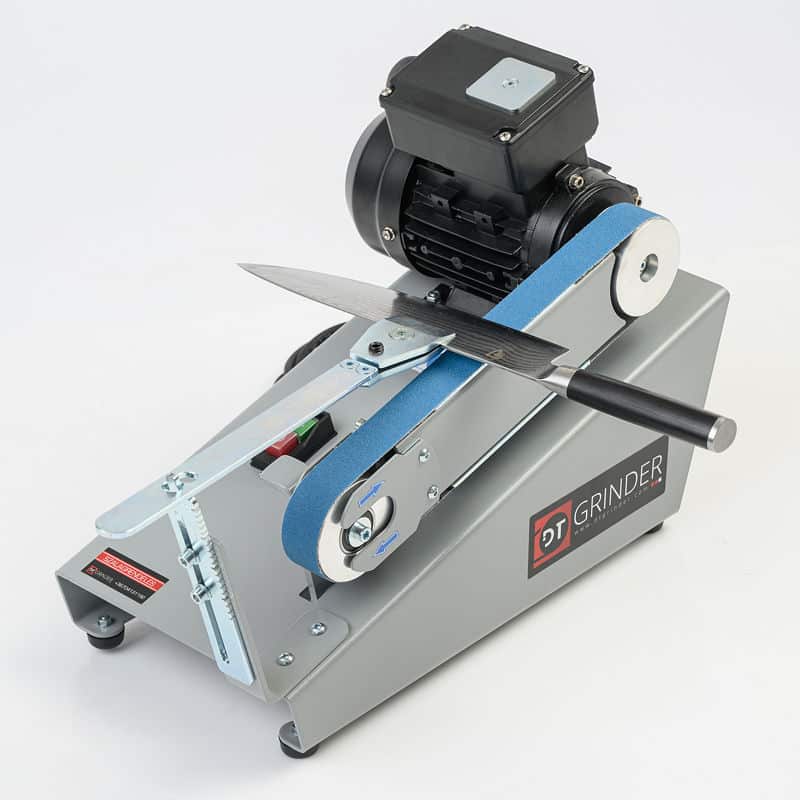
How to Choose the Right Grit Size Sanding Belt for Specific Sanding Jobs
Selecting the proper grit size sanding belt is essential for efficient sanding and achieving the desired surface quality. Grit size is typically indicated by a grit number, and as the number increases, the abrasiveness becomes finer. Below are some general guidelines for different sanding tasks:
1. Coarse Material Removal (Removing Larger Quantities of Material) Grit Size: 24–60
Recommended Uses:
Removing thick layers of material (e.g., rust, paint, or heavy surface irregularities).
Initial steps in metal and woodworking where heavy material removal is needed.
Shaping weld seams and rough edges.
Example:
When removing large amounts of material from a knife blade or shaping the blade, a 40 or 60 grit sanding belt is ideal.
2. Medium Material Removal (Rough Sanding and Smoothing) Grit Size: 80–120
Recommended Uses:
Smoothing surfaces after coarse sanding.
Shaping and refining rough edges.
Preparatory sanding before painting or varnishing.
Example:
To prepare a knife edge or smooth out materials further, an 80 or 120 grit sanding belt will provide a uniform surface.
3. Fine Sanding (Surface Preparation for Painting, Varnishing, or Polishing) Grit Size: 150–220
Recommended Uses:
Smoothing surfaces before painting or varnishing.
Refining surfaces after coarse sanding to prepare for final finishes.
Fine edge shaping after sharpening knives.
Example:
For fine sanding of a knife blade or preparing for polishing, use a 180 or 220 grit sanding belt.
4. Ultra-Fine Sanding (Final Finishing and Polishing) Grit Size: 320–600 or Finer
Recommended Uses:
Final surface finishing to achieve the smoothest texture.
Pre-polishing sanding and precise edge sharpening, especially for knives and other precision tools.
Preparing wood or metal surfaces for a smooth, reflective finish.
Example:
For polishing a knife blade to a mirror-like finish, choose a 400 or 600 grit sanding belt.
Polishing extremely fine surface materials such as glass or metal.
Creating mirror-smooth, glossy surfaces for specialized projects.
Example:
For an ultra-smooth, mirror-polished knife blade, use a grit size of 1000 or finer.
General Tips:
Start with a coarser grit size if significant material removal is needed, then gradually switch to finer grits for a smoother, more uniform surface.
When sanding heat-treated materials, ensure you choose the right grit size to prevent excessive heat buildup. Start coarse and progressively move to finer grits.
Avoid skipping too many grit sizes between sanding belts. If the finer belt cannot remove marks from the previous grit, it may complicate your work.
The best grit size depends on the type of work and the final surface finish requirements.
By following these guidelines, you can achieve efficient sanding results tailored to your specific project needs.
To provide the best experiences, we use technologies like cookies to store and/or access device information. Consenting to these technologies will allow us to process data such as browsing behavior or unique IDs on this site. Not consenting or withdrawing consent, may adversely affect certain features and functions.
Functional
Always active
The technical storage or access is strictly necessary for the legitimate purpose of enabling the use of a specific service explicitly requested by the subscriber or user, or for the sole purpose of carrying out the transmission of a communication over an electronic communications network.
Preferences
The technical storage or access is necessary for the legitimate purpose of storing preferences that are not requested by the subscriber or user.
Statistics
The technical storage or access that is used exclusively for statistical purposes.The technical storage or access that is used exclusively for anonymous statistical purposes. Without a subpoena, voluntary compliance on the part of your Internet Service Provider, or additional records from a third party, information stored or retrieved for this purpose alone cannot usually be used to identify you.
Marketing
The technical storage or access is required to create user profiles to send advertising, or to track the user on a website or across several websites for similar marketing purposes.




![Gumírozott görgő Ø 45 [mm]-es méretben](https://dtgrinder.com/wp-content/uploads/2023/09/ruberrized_castor_small_wheel_gumirozott_gorgo_5.jpg)


![Gázteleszkóp 200-60 [mm] 200N - DTG-BG1200 és DTG-BG2000 Szalagcsiszológépekhez](https://dtgrinder.com/wp-content/uploads/2025/03/gazrugo_200N.jpg)