Many people believe – and this is prominent on social media and in various forums – that the cutting and usage properties of a knife are primarily determined by the type of sharpening. In other words, it is often debated whether:
where to find,
convex, or
the knife should have a straight (FFG) edge.
(Of course, there are other types, such as chisel, katakiriba, skandi, etc., but these are the basics.) It is generally believed that the holkeres is the most fragile, the convex the thickest and most stable, and the straight is somewhere in between.
But this is only true – and not always clearly true – if all other conditions are exactly the same. These include blade thickness, the angle and thickness of the facet (edge band).
These factors are often overlooked, partly because they are harder to measure and less visible.
The following summary is based on several years of practical experience.
What are the characteristics that most affect the ability to cut?
So what are the other properties that affect the cutting properties of a knife?
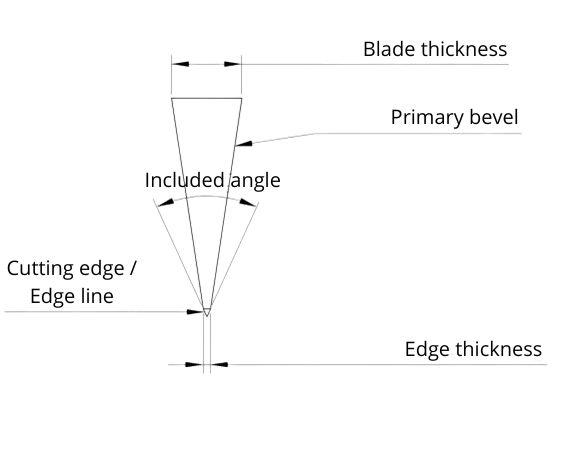
Thickness of the facet – how far down the leading edge is
Edge angle – angle subtended by the pins drawn at the edge in the case of a convex edge
Blade thickness – initial material thickness measured at the blade back
Practical experience has shown that the most noticeable difference is the difference in the thickness of the facet, i.e. the thickness of the grinding edge.
In the case of a convex edge, it is difficult to measure this precisely, but in fact if we imagine the convex as a straight-edged blade with an edge band whose edge is “flush-edged”, i.e. the planes of the leading and cutting edges are flush-edged either on a soft abrasive belt or on a vibrating belt, then it is perhaps possible to see that we can talk about facet thickness, even if a little more arbitrarily.
These properties (once again, the thickness of the facet, the angle of the edge band and the thickness of the blade) determine the cutting properties of a knife more than whether the section between the edge band and the two points on the blade back is straight, straight or, if applicable, convex. This is also an important attribute, but in my opinion the other attributes are generally more decisive.
Grouping of knives by use
For the interpretation of specific values, it is useful to group the knives by use. The following classification is simplified but can be used in practice. There are of course overlaps and individual preferences
Group 1 – fine cutting tasks
Razors
Carving knives
Vegetable peeler knives
Small knives and folders
Group 2 – general use
EDC knives and folders
Smaller fixed blade knives for everyday use (typically with blade thickness below ~4 mm)
Kitchen knives (not cleavers and not tapping knives)
Group 3 – more demanding
Outdoor knives (bushcraft, hunting etc.)
Bigger and stronger EDC knives
Utility knives
Of course, these categories can be further broken down, e.g. razors could be taken separately, but even within the outdoor category, they could be further subdivided into subgroups (e.g.: machete knives, etc.) However, if we remember these three categories, we can’t go very far wrong.
Let’s look at these more specifically, at the level of numbers in a table.
Typical size ranges
Knife Group
Facet thickness
Angle of edge strip
Group 1
~0,15 (razor) – 0,3 mm
~10-15°
Group 2
~0,3 – 0,5 mm
~15-20°
Group 3
~0,5 – 1,0 mm
~20-30°
It is important to note that the thickness of the facet and the angle of the edge band do not always fall into the same category, and the above values are based on practical experience, but should not be considered a universal rule, as the specific application is always the determining factor. Each person should judge these properties of knives based on their own knowledge (not from online and other places).
The article is based on the writing and experiences of Imre Palcsesz, knife maker (angelero.hu). Thank you for sharing your professional experience!
To provide the best experiences, we use technologies like cookies to store and/or access device information. Consenting to these technologies will allow us to process data such as browsing behavior or unique IDs on this site. Not consenting or withdrawing consent, may adversely affect certain features and functions.
Functional
Always active
The technical storage or access is strictly necessary for the legitimate purpose of enabling the use of a specific service explicitly requested by the subscriber or user, or for the sole purpose of carrying out the transmission of a communication over an electronic communications network.
Preferences
The technical storage or access is necessary for the legitimate purpose of storing preferences that are not requested by the subscriber or user.
Statistics
The technical storage or access that is used exclusively for statistical purposes.The technical storage or access that is used exclusively for anonymous statistical purposes. Without a subpoena, voluntary compliance on the part of your Internet Service Provider, or additional records from a third party, information stored or retrieved for this purpose alone cannot usually be used to identify you.
Marketing
The technical storage or access is required to create user profiles to send advertising, or to track the user on a website or across several websites for similar marketing purposes.


![Gumírozott görgő Ø 20 [mm]-es méretbenMinden gumírozott görgő felülete szabályozott ezáltal biztosított a vibráció mentes sima futás.A görgő a rádiuszcsiszoló feltéttel alkalmazhatóak, de ha nem a DTG-BG2000 típusú gépeken szeretné valaki alkalmazni, akkor elérhető hozzá egy tartókonzol külön is, amit saját felfogató rendszerére tud felszerelni a felhasználó.](https://dtgrinder.com/wp-content/uploads/2023/09/ruberrized_castor_gumirozott_gorgo_2.jpg)